01 — The Problem
More filters don't mean a better decision
There's a well-documented effect in decision psychology called choice
overload — past a certain point, adding more options doesn't make
people more satisfied with their decision, it makes them less
confident in it and more likely to second-guess or abandon it
entirely. Booking sites are built almost in defiance of that finding:
location, price, dates, guests, amenities, cancellation policy, host
rating, and on and on, each filter narrowing the list while widening
the mental load of the person using it.
Nobody plans a trip by thinking in checkboxes. You think in a
sentence — "somewhere walkable to the beach, pet-friendly, under
$200 a night, room for the dog" — and then you spend twenty minutes
translating that sentence into a form. StayFinder skips the
translation step.
If more filters make people less confident in their choice, why is filtering still the default interface for booking a trip?
02 — Design Approach
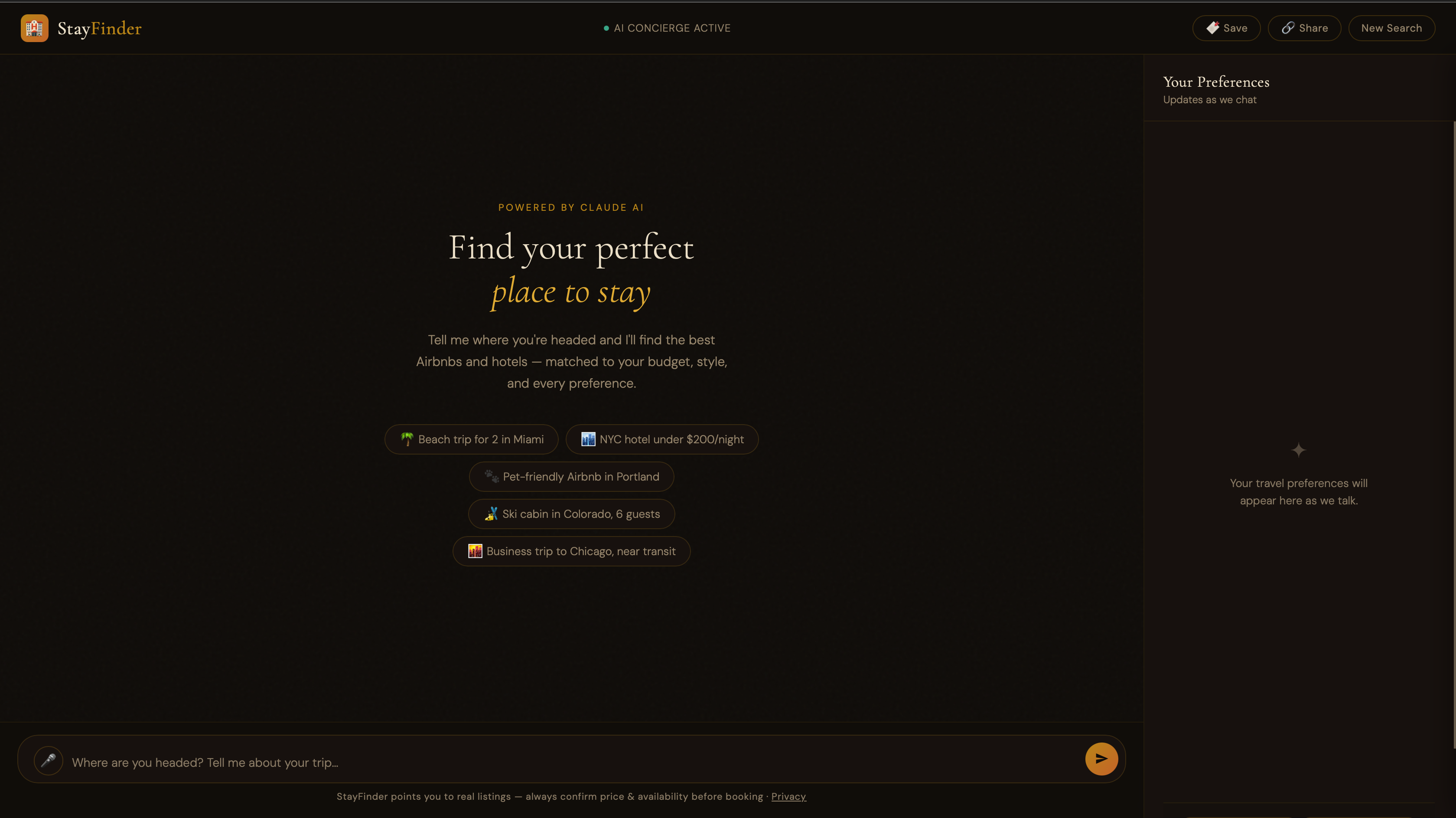
Conversation as the interface
The core interaction is a chat with Claude that asks the right
follow-up questions — destination, dates, guests, budget, vibe — and
searches real listings once it has enough to work with. The design
challenge wasn't the chat itself; it was making an AI-driven flow feel
trustworthy and legible rather than like a black box.
A live preference sidebar solves that. As the conversation progresses,
a running summary fills in — destination, dates, budget, amenities —
so the user always sees exactly what the AI understood, with a
progress bar toward "ready to search." Results land on an interactive
map with clickable pins, and any two or three listings can be pulled
into a side-by-side comparison table with best-price and top-rated
call-outs.
03 — What Shipping Taught Me
The chat UI was the easy part
The interesting growth on this project happened underneath the
interface, rewriting decisions I'd made too quickly the first time
through. My first version called the Anthropic API directly from the
browser with the key sitting in localStorage — fine for a demo,
unshippable for real people. I rebuilt the whole request flow behind
a Vercel Edge Function so the key never leaves the server, and moved
off regex-parsed <TAGS> in plain text onto
structured Claude tool calls, so the model returns typed, reliable
data instead of me hoping its output matches a pattern.
Security
Server-Side Proxy
Reliability
Structured Tool Calls
Design System
Figma Token Sync
Resilience
Graceful Demo Fallback
Abuse Protection
Rate Limiting, Fail-Open
Product Ethics
No Fake Booking Flow
Before the link went public, I added per-IP rate limiting at the edge
and a hard monthly spend cap — the cap exists specifically as a
backstop in case the rate limiter itself ever fails. And when it does
fail, it fails open: a Redis hiccup degrades to an
unthrottled request rather than taking the whole app down. That's a
deliberate tradeoff between cost protection and availability, not an
oversight.
I also learned that owning a mistake is part of the job. An early
commit accidentally hardcoded a live Mapbox token directly in
client-side code. Instead of quietly fixing it, I documented the
token as burned in the deployment notes, rotated it, and wrote down
why — so the next credential doesn't end up in a commit either.
The most deliberate decision in the whole app might be the smallest
one: there's no "Book Now" button. Real booking requires
affiliate-level API access I don't have yet, so rather than fake a
booking flow that can't actually confirm a reservation, every listing
links out to a real search on Airbnb or Booking.com. It's a permanent
product decision, not a launch-week shortcut — an AI product should
never let a confident-sounding interface promise something it can't
back up.
04 — Outcome & Reflection
A live product, not a portfolio piece
StayFinder is deployed and usable today, not a mockup sitting in a
design file. That distinction mattered to me — it's one thing to
design a flow, another to see it survive contact with a real API,
real network conditions, and real edge cases. Getting it from "looks
right in Figma" to "works when someone else opens the link" was the
actual project.
The goal was to make vacation planning feel less like a second job —
for someone booking their first trip or their fiftieth. It's still
evolving, and the repo is public if you want to see exactly how it's
built.